
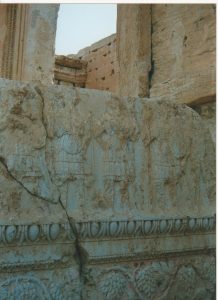
Prior to becoming a Roman Province in 64 BCE Palmyra is thought to have been organised in the Greek style with a Senate and an Assembly, her architecture reflected Greco-Parthian influences from Babylon and Seleucia. Under Roman rule it fell under the domination of the Roman legate at Antioch with corresponding influences on her art and architecture. The ruins of the ancient city stretch across more than 10 kilometers squared and it was of a similar size to Antioch then capital of Syria. During the time of Septimus Severus 193-211 a monumental arch, the remains of which were restored in 1930 by the architect Robery Amy, was erected. Its rich decoration includes acorns and oak leaves, pearls and palm trunks, acanthus and vine leaves. Other forms of architectural decoration discovered in the Temple of Bel at Palmyra included local examples of vine scrolls with single vine leaves and enticing bunches of grapes. These are considered without parallel in the Graeco-Roman art of the time (1st century BCE), and are thought to have influences from Iran further east.

Situated to the south west of the arch is the Temple of Nabu one of a number of temples to a variety of gods and goddesses found in the city. One of the pantheon of Mesopotamian gods Nabu, god of wisdom and writing, was the son of the Babylonian God Bel-Marduk and was identified with the Greek Apollo. The temple which stood on a podium 2.15 meters high was surrounded by thirty two Corinthian columns. The terraces of the temple are crowned with merlons. The remains of the Temple of Baalshamin, the god of storms and fertilizing rains, is found in the northern area of the city and its cella is very well preserved. Animal sacrifices of camel, cattle and sheep were made to the god on the temple altars. More than one thousand different types of small baked clay tesserae have been found in the temples of Palmyra and were used as tokens permitting those in possession to take part in the ritual banquets that followed such sacrifices. We may recoil at such apparent horrors but how many of us continue to consume the same meat with relish.


Further west are the ruins of the Baths of Diocletian its entrance flanked by four granite columns imported from Egypt. Like any respectable Roman Baths it has a frigidarium, a trepidarium and a calidarium, a dressing room and lavatories. Along the main street that served these buildings opened the fronts of many small shops whose merchants must have availed of the facilities provided by the local baths. A stone phallus once graced the entrance to similar Roman Baths amongst the ruins of Douga in Tunisia but was removed in recent times to accommodate local sensibilities. I am not aware if the Baths in Palmyra were ever used to the ends suggested by the offending item. On a more lofty note the Theatre lay not far away and for those not inclined to dally in the steam there was no doubt much to be seen from the playwrights of Greece and Rome and one can only wonder if there were any local artists of worth who might have had their first chance of fame on the floor of this impressive edifice.

With its temples, and theatre, its baths, its shops and houses, its small senate building and its agora with eleven entrances where statues, dedicated to the officials, military personnel, merchants and caravan leaders of the city, once graced these sites the ruins of Palmyra rise from the desert in testament to its former grace and grandeur and leave the visitor in no doubt that this was a city to be proud of and which at one stage of its development had a female ruler to be reckoned with in the person of Zenobia.


