
In the delta between the two great rivers of Mesopotamia is the triangle of marshlands that lie between the towns of Nasiriyah, Basra and Amara. In the central marshes, the waters of these two rivers meet near the town of Qurnah and run together into the Shatt al Arab. The Huwaizah marshes are further east, towards the border with Iran and lying to the west were the Hammar marshes which we would visit next morning. We sat by the banks of the Tigris absorbed in thoughts of this ancient place where the city state of Ur once ruled over Sumeria.
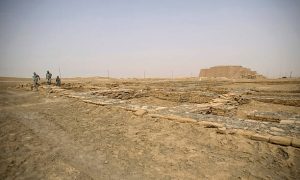
Part of its well preserved Ziggurat stood only 15 kms. from where we sat; a reminder of the people who not only built that world renowned city four millennia ago but invented objects that would play such an important role in the development of civilization, the plough, the wheel and the sail. As the sun lowered in the sky we abandoned the bag of inedible sweets we had bought earlier in Nasiriyah and made our way back to the hotel where arrangements were in progress for dinner. The manager had kindly agreed to have one of the large pots of food we brought with us heated in the kitchen. We gathered in one of the bedrooms and open a bottle of wine to celebrate our arrival in this timeless paradise. Later, when all thoughts of work and responsibility had disappeared, we made our way down to the dining room where a long table had been prepared for us in a corner of the dark room. Freshly made salads were brought from the kitchen along with rounds of the flat bread that had become part of our staple diet. Flickers of candlelight flashed across the sun kissed faces of the diners like the glow from a Rembrandt painting, as the evening slowly developed into a misty memory of pleasure.
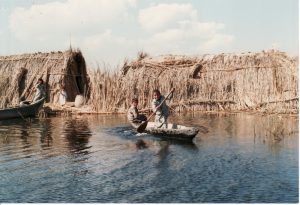
Next morning, following a light breakfast of bread, a soft local cheese, and some dates washed down with a cup of Nescafé we drove with Abdul to the edge of the marshes where flat narrow boats were waiting to take us across to the reed islands. A group of local children gathered around to watch, using their school English to elicit the small gifts we had brought along for exactly this purpose. I am always amazed at the willingness of Arabic children, no matter how small, to use their rudimentary foreign language skills in the service of extracting presents from visitors without the slightest trace of bashfulness. There is something to be said for such an enterprising spirit. Waving the children goodbye, we stepped precariously into one of the black flat bottomed boats and sat on the wooden planks stretched across its width. Close to the surface of the water we could run our fingers through the cool liquid. The motor powered boat moved swiftly over the shallow water channels which were lined with tall spring-green reeds. The sun was shining with the sapphire blue of the sky strewn with light streaks of milk white cloud. A slight breeze brought our senses alive to the beauty of the natural surroundings. A graceful mashoof, one of the long narrow boats traditionally used in these waters, drifted by. It was propelled by a silent dark figure that dipped a long pole into the water and used the power of his body to push the boat forward over the shallow waters. A variety of fish abounded in these waters, providing part of the staple diet of the inhabitants. A variety of birds make their home here and migratory birds stopover on the long journey between Eurasia and Africa. The area is also home to the water buffalo, whose milk was used by the local marsh-dwellers or Mad’an to make a soft white cheese. The boat pulled into a small opening and rested its prow on a bank of matted reeds, leaving the stern buoyant in the shallows where the separation of reed and water became blurred. Hopping from the boat with the dexterity of a man who has spent all his life moving from water to floating island, the boatman extended his hand to help those of us more accustomed to dry land to negotiate our first steps onto this moving mass. Sinking into a soggy squelch of soaked reeds I stumbled, before finding a more solid sandy footing away from the water’s edge.
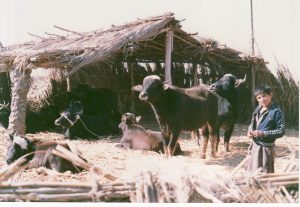
This island is known as a dibin one that has a greater degree of permanency on account of the layers of mud that covered the reeds away from the water’s edge. The more transient islands of layered reeds are known as kibasha but the positions of all the islands changed to some degree with the movement of water. The smell of fresh and rotting organic materials assailed our nostrils as an orchestra of frogs erupted in a chaos of croaking, which reached a crescendo on our arrival and settled into the background as we became used to their constant presence. Walking past a group of small tent-like structures made from woven reeds we noticed a small child who had been placed outside on a blanket with a conical hat protecting his head from the sun. As I bent down to take a closer look beneath the rim of his green cap, the child’s small face crumpled and he let out a loud wail which brought his mother running out from one of the small huts to rescue her distraught child. Laughing good naturedly, she scooped the tiny bundle up in her arms and quickly disappeared back into the womb-like interior of the reed- tent. A small herd of cattle sheltered beneath a roof of woven reeds supported on wooden poles and the sturdy trunk of a date palm. A young boy stood amongst the cattle in this open air barn, dressed in a mud coloured dishdashe which was covered with a blue striped tracksuit jacket. He turned to look as we passed by, noticing our look of amazement at seeing cattle housed in such watery surroundings. Hens ran around underfoot pecking at patches of scattered earth. Everywhere on this small island there was movement. Over to one side a group of men were completing the skeleton of what would become a large mudhif, a guesthouse built in the decorative reed architecture traditional to these islands. Thick semi-circular bands of reeds towered over the foundations. Placed a few meters apart they would support the matting and latticework covering of the house of communal gathering. Small tree saplings growing close by were sustained for a time by the island’s covering of mud.
To be continued………..

It’s so wonderful you experienced the real Iraq. As with most countries the countryside is another place altogether.