
Travelling alone as a woman in the Middle East I have enjoyed using public transport for the contact it afforded me with local people who I have always found most courteous and helpful. On the bus journey from Damascus to Palmyra passengers were provided with a plastic bag containing two small packets of biscuits, a hand wipe and a plastic cup which was topped up at intervals with water from a flask. We were even offered a hardboiled sweet from a decorative wooden box inlaid with mother of pearl that looked so well worn it could have been added to the display of crafts at the museum. On a couple of occasions when newly arrived male passengers attempted to sit next to me they were politely asked by the conductor to avail of another seat, and where none was available my permission was sought. All lone female travelers whether local or foreign were treated to this same courtesy.
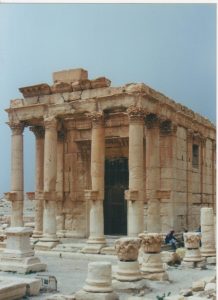
Most of the journey to Palmyra was through desert scrubland and my sleepy senses were awakened at a point where a row of heavy good vehicles stood in line at a border crossing. I spotted the signpost for Baghdad and was overcome with longing to return to that city where I had lived and worked many years previously. Little did I know then that I would find myself doing exactly that within a few short years. For now my attention was focused on seeing the faded splendors of Palmyra and it was not long before the imperial columns of the great colonnade rose up before me, a tantalizing glimpse from the bus as it passed on into the new town and deposited its passengers in front of the local museum.
Palmyra derives its name from the date palm and is known in Arabic as Tadmor from the Semitic word tamr meaning date. In their Guide to the Historic Monuments and Museums of Palmyra Dr. Adnan Bounni and Khaled al-As’ad mention an Assyrian contract found in Anatolia dated around 1900 BCE and also in cuneiform letters from Mari at the time of Hammurabi (18th century BCE). Built on an oasis in the Syrian Desert with the Orontes River 160 kilometres to the west and the Euphrates even further to the east it lies at the final fold of the Anti- Lebanon mountain range and forms a basin from which the Efca spring emerges to which the oasis owes its existence. There is evidence to suggest that Neolithic people settled and farmed this area.
Lying between the Roman and Parthian Empires in the first century BCE Palmyra was transporting goods between the two and successfully dealing with both empires, having the advantage of skilled mounted archers who are mentioned in the Talmud. The Romans used Palmerian archers in their armies and there are records of Palmerian soldiers serving at the Roman Wall in Northumberland.
Palmyra was nominally incorporated into the roman province of Syria under the Emperor Nero in the first century CE. Prior to its rise to prominence in the 2nd century CE it lived in the shadow of Petra, “the rose red city” hewn from rock and the Nabatean capital in what is now the Jordanian desert. As the Romans under Trajan subjugated the kingdom of Petra in the early 2nd century CE and Antioch became a center of Roman power, Palmyra emerged as an important trading post between the Romans in the Eastern Mediterranean, and the Parthians in the Gulf. The taxes levied on the caravans that moved through the area increased its prosperity so that within thirty years after the fall of Petra “slaves, dried food, spices, silk, ebony, incense, ivory, jewels and glassware”, were traded through Palmyra, and increased the riches of its merchants who began to build on a lavish scale. A visit by the Roman Emperor Hadrian was financed by a particularly wealthy local merchant know as Male Agrippa who was also rich enough to fund the rebuilding of the Temple of Bel. Hadrian declared Palmyra a “free city”, thus enabling it to set and collect its own taxes. The city was subsequently named Palmyra Hadriana for a short period. The economic activity of the area spread and it became an important post on the Silk Road transporting goods from China and India to the Mediterranean and Europe.
As a colony of Rome and thereby exempted from paying taxes to Rome, Palmyra evolved into a kingdom which from 252 CE was ruled by Odenathus a brilliant military leader who defeated the Sassanian King Shapur at Ctesiphon in modern day Iraq. The previous year Shapur had defeated the Emperor Valerian who was taken into captivity. Valerians successor Gallienus declared Odenathus “Corrector of the East” in 256 CE. He was murdered in 267 leaving his second wife Zenobia as regent on behalf of their young son Vaballathus.
Zenobia is reputed to have been intelligent, beautiful and capable of great physical endurance. She had a variety of intellectual interests which included history and philosophy and she spoke Greek, Aramaic, Egyptian and some Latin. Longinus, a Greek Philosopher who was educated in Alexandria before it was sacked by troops from Palmyra and taught in Athens until it was was sacked by the Goths in 268 CE, was given refuge by Queen Zenobia and became an advisor. She was also on good terms with the Bishop of Antioch, Paul of Samosatha. A descendent of the Ptolemaic Queen Cleopatra, Zenobia was considered “to have far surpassed that princess in chastity and valour”, according to Edward Gibbons. Her dark complexion, black eyes and pearly white teeth commanded a great deal of attention in the literature concerning her a bit like the attention given to such details in the modern media when it comes to reporting on women. “In speaking of a lady these trifles become important” as Gibbons points out but whatever her charms she was certainly ambitious and was later accused by the Romans of having been involved in her husband’s demise, most likely a slur on her character for having defied Rome.

As the trade route through the Gulf was cut off by the Sassanians, commercial considerations caused Zenobia to expand into Egypt and Anatolia and she had ambitions to become ruler of the Roman Empire in the East. Aurelian who became Emperor in 270 CE decided to put a stop to her undertakings. He marched against her and caused the Palmyreans to withdraw to Emesa (present day Homs), which was then the capital of Syri-Phoenicia. Recognizing there could be no compromise Zenobia proclaimed her son Augustus and herself Augusta and laid claim to the Roman Empire issuing coins on which her head alone appeared rather than with that of the Emperor, and thus assured her own downfall. Some of these rare Syrian coins were found in Alexandria and are presumed to have been minted in Emesa.
Knowing the game was up the queen retreated to Palmyra which was hastily fortified as Aurelian and his army followed in quick pursuit. Not being one to give up easily Zenobia appealed for help to the Sassanian Shapur but the Romans dispersed the troops that were sent to help her as dispersed the Bedouin who attached them from the desert. Aurelian offered generous terms of surrender but Zenobia refused them. She tried to escape by crossing the Euphrates but was captured and was eventually led in Triumph to Rome bound in gold chains and complaining about the weight of her gems.
“If only they knew what a woman I have been fighting”, Aurelian is said to have responded to the Senate’s derisive attitude to his Triumph over a woman; “what would History say if I had been defeated by Zenobia?” As little as possible I suspect as I remember my ten year old niece informing me over a decade ago that she had asked her teacher why all the History she was learning was all about men. Zenobia is reputed to have lived out her days in a Villa in Tivoli having been married off to a Roman Senator. Gibbons accuses her of having sunk insensibly into the life of a Roman matron and criticizes her for having saved herself by sacrificing her advisers and friends, including Longinus.
To be continued..


