Educated by the nuns, I had always resented the supposed superiority of men implicit in male monotheism, reinforced by their every gesture of deference to the male sex. Once old enough to decide for myself I had refused to have anything to do with such discriminatory assumptions. Now here in this ancient land where the goddess was raised up to be the equal of man I was reminded just how ill women have been served by the idea of an exclusively male god and how the repercussions of this travesty continue to plague us in our daily lives.
Wandering around the deserted site we came upon the large basalt sculpture which represented the goddess Ishtar as the Lion of Babylon with the figure of a man lying beneath. The well-worn sculpture still bears traces of the outline where a saddle was once placed to hold an image of the goddess. Gwendolyn Leick, anthropologist and Assyriologist, says that the women who associated themselves with Inanna were free from the narrow bonds of patriarchal marriage and represented the transcendence of the controls imposed by social norms; a more sophisticated understanding than that usually ascribed to unmarried women who are often treated as if they have somehow failed in not living up to societies expectation that they marry and bear children. Not surprisingly transsexuals and homosexuals those others who do not fit into conventional norms , were included in the rituals surrounding the goddess.
The cult of the goddess recognized the ambivalent nature of sexuality which was not acknowledged in the modern era until Freud identified the essentially bisexual nature of humanity in the twentieth century. The goddess represented a broader understanding of human sexuality and recognised the fact that Nature likes diversity and always will. The fact that homosexuality exists in the animal kingdom of which we are all a part gives the lie to the prejudice that homosexuality is unnatural but it appears that some humans think they know better than the very Creator in whom they believe.
As we walked through the remaining traces of the processional way, we followed in the footsteps of those who once passed under Ishtar’s triumphal arch at the time of the New Year Festival to make their way to the seven storied Ziggurat known as Esagila, which stood close to the temple of Bel-Marduk. In the first millennium B.C., the festival took place over a period of eleven days during March-April, to celebrate the rebirth of nature and the restoration of divine order over the chaos brought about by the disappearance of plant life during winter. Early on the fifth day of the festival the temple of Esagila, which means the lofty house, was purified with cedar resin mixed with water from the Tigris. A sheep was sacrificed as the “scapegoat” who took away the sins of the previous year. That evening the king surrendered the insignia of his office, the sceptre, the circle and the mace and was struck on the face by a priest in the presence of an image of the supreme Babylonian god Bel-Marduk. The king bowed down and gave an account of his reign. He was then reassured by the priest that the god would hear his prayers and exalt his kingship. Once the king had atoned for his sins the priest again struck his face and reminded him that he owed his powers to the god, before his insignia were returned and his kingship resumed.
Babylon was once a simple mud brick village much like those that are still to be seen on the outskirts of Baghdad. It is thought to have first become a city after the collapse of Ur around the end of the second millennium BC. One of its best known kings was Hammurabi, who ruled for forty-three years between 1792 and 1750 B.C. Known as the lawgiver he was responsible for having Babylonian law systemized into a code “so that the strong may not harm the weak”. A copy of the original code in the form of an eight foot diorite stela inscribed with 3000 lines of cuneiform can be seen in the Louvre. It was discovered in 1901 by a French archaeologist working in Elam in modern day Iran.
It was during the reign of Hammurabi that Marduk the god of Babylon became one of the greatest deities. During his reign innovative cultural changes took place such as the depiction of movement into the popular art of the time. George Roux, a French medical doctor and Assyriologist, who worked with the Iraq Petroleum Company during the 1950’s describes some of the reliefs from everyday life. One depicts a date gatherer climbing a tree, another of a bitch feeding her puppies, and even one of a couple making love.
It was also in the time of Hammurabi that the epic of Gilgamesh was recorded. The oldest know epic of mankind, it tells the story of Gilgamesh, a mythical figure whose name is associated with that of a king of Sumerian Uruk, who was two thirds immortal and created in the image of man. The story deals with common human experiences of love, friendship, desire, hope, loss, and the inevitability of death. More than 4,000 years old the epic of Gilgamesh is highly regarded for its poetic beauty and is thought to be the origin of the later Greek myth of the trials of Hercules. Just like us, our ancient ancestors struggled with the common themes of humanity– friendship, love and mortality, and developed religious beliefs as a means of coping with the uncertainty of life and the inevitability of death. A copy of the epic was found on cuneiform tablets, which had been collected from all over ancient Mesopotamia, in the library of the Assyrian King Ashurbanipal (669-631 BC)
Walking through rubble of fallen mud brick we came to a grove of palm trees that led us down to the Tigris, famous as the waters beside which the exiled Jews grieved for their lost homeland. On the opposite bank, a group of women were washing pots and metal platters. The women held their long robes up above their knees with one hand while using the other to scoop water into their vessels. Swirling the water around with graceful movements of the wrist they poured it back into the flowing river. As the women worked their barefoot children played with abandon on the sandy banks. We stopped for a while in the seclusion of the palm grove to watch as the women went about a practice that has changed little over the centuries. As we absorbed the timeless scene Mary my companion took out a small paint box and with a few strokes of her brush sketched an aide memoire for a future painting. As we continued to observe the women absorbed in their daily chores I recalled the writings of a 19th century traveler who once walked these very banks. Coming across a similar group of women he was astounded when on sighting him they lifted their long robes to cover their faces. The fact that they revealed bare genitals in the process was of little concern compared to the shame they would have felt if the cultural taboo of showing their faces to a strange man had been violated; fannies are one thing but faces quite another.
Babylon would eventually be taken under the influence of the Assyrian Empire, which rose in the north of Mesopotamia in the area around present day Mosul. After the fall of the Assyrian Empire in 612BC, Babylon once again became a powerful independent state. Some Assyrian Kings had sponsored architectural developments in Babylon but it was the developments that took place during the reign of Nabopolassar and his son Nebuchadnezzar II that made it world renowned. What was left of the old Ziggurat which probably dated back to the time of Hammurabi was destroyed in 689 BC during the reign of the Assyrian King Sennacherib. Nabopolassar had the ziggurat reconstructed and expanded. It contained the chapels of the gods and became known to us as the tower of Babel. This stepped ziggurat, build in the Sumerian style, contained the monumental bed of Marduk and was central to the rite of sacred marriage celebrated at the time of the New Year Festival.
Nebuchadnezzar II is one of the best known neo-Babylonian kings. His palace is identified with a mound which was excavated by the aforementioned German archaeologist Koldewey. It lies to the right of the riverbank and is known as Kasr or castle. The interior of the palace, which was raised upon a platform of burnt brick, “was suitably luxurious, with rich wood panelling inlaid with ivory and lapis lazuli. The walls of the throne room were glazed with the same blue tiles as the Isthtar Gate and were decorated with palm trees and rampant lions.”
The now desolate landscape is peopled with figures that rise from the recesses of consciousness like the bitumen that once oozed from the land. Then as now there was the occasional queen or queen mother who played a prominent public role ensuring that their names would live on through the ages. Semiramis, one of the two most famous queens of Babylon, is attributed with being responsible for the building of an embankment to control the waters of the Euphrates and prevent flooding of the countryside. A figure of legend she is thought to incorporate traits of Naqi’a-Zakutu, chief wife of the Assyrian King Sennacherib, who organized the reconstruction of Babylon following its destruction by her husband.
Adu –Guppi was the mother of Nabonidus, who reigned in Babylon following the death of Nebuchadnezzar. A possible descendant of the Assyrian Royal house she was an important link between the Assyrian and Babylonian Empires. Along with building great embankments she is also attributed with building a bridge over the Euphrates which ran through the center of the city and was crossed by boat. She was instrumental in having the course of the Euphrates diverted so that the frequent bends would reduce the rivers flow and make it more difficult for potential invaders to come directly into the city. She lived happily and in good health for one hundred and four years and had many great-great-grandchildren. When she died in 547BC, her son erected two stelae at the Moon Temple of Harran where she had been a functionary. The records state that she lived from the time of Ashurbanipal, King of Assyria (685-627BC), to the ninth year of her sons reign in Babylon.
Her son, whose allegiance like that of his mother was to the Moon god Sin, spent a continuous period of ten years away from Babylon in Arabia leaving his son Bel-shar-usur or Belshazzar as co-regent in Babylon. Apart from his involvement in rebuilding the old city of Harran, it is thought that the king was interested in capitalizing on the incense and spice trade which ran through the Arabian Desert, although others suggest he had fled Babylon during a time of civil wars and famine. Belshazzar’s poor political skills resulted in the strengthening of pro-Persian sentiments among the Babylonians who thought they would fare better under the rule of Cyrus. Not long after his father’s return to Babylon the army of Cyrus II defeated the Babylonians at the Battle of Opis in 539 BC, putting an end to Babylonian independence.
Recording his visit to Babylon, Herodotus said that the Chaldean priests of Bel told him that twenty-two tons of gold were used to make the figure and throne of the god, along with a golden base and golden table. He described the artificial irrigation that was used to grow an abundance of wheat, barley, millet and sesame which was then their sole source of oil. Fruit bearing palm trees were then ubiquitous and the dates were used as food and in wine making just as they are today and the palm fibers were used to make rope, matting and baskets.
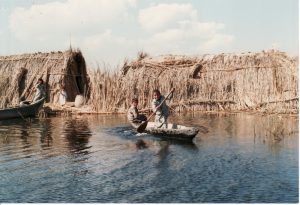
What surprised Herodotus most of all about this great city was the circular boats which were made from hide stretched over willow twigs and filled with straw. The boats came down river from the source of the Euphrates in Armenia with their cargo of wine in palm wood casks. Steered with paddles by two men, every boat carried a donkey. Once the wine was sold in Babylon the merchant disassembled his boat and sold the frame and straw. Loading the skin on the back of his donkey he made the return journey by land as the rapid currents of the Euphrates were too treacherous to navigate upstream. At the time of Herodotus’s visit in the fifth century B.C., many of the people of Babylon lived in two or three storied houses made of mud-brick, similar to the mud-brick village we had seen on the outskirts of Baghdad. Others lived in reed huts, fine examples of which I would later see in the marshes of Southern Iraq.