
As I watched the vines grow in the nearby fields and observed the bunches of grapes begin to soak up the summer sun I returned to a nice little publication I found some months back called 100 Chateaux Qu’il Faut Connaitre a Bordeaux. Deciding it was time to tase some French wine I opted for one of the day tour of the Margaux Region offered by the Tourist Information Office in Bordeaux. Rather than drive on the French motorways which I find hair-raising at the best of times I took the train from my nearest train station in Montendre to St. Jean in Bordeaux where a very cheap and efficient tramline took me from the station almost to the door of the Tourist Office. Our guide was Brigitte and our group included French, American, Australian, and Spanish wine enthusiasts. On the journey Brigitte gave us some information about French viticulture, the most important aspect of which is terroir which includes the natural environment and local tradition, the grape being purely the medium by which this magical entity is transferred to the mouth of the consumer.
The grape variety in itself tells us nothing she informed us no more than the name Brigitte tells us anything about the hundreds and thousands of women so named. Associate the name Brigitte with that of Bardot and, if of a certain age, we can easily conjure up the characteristics of that particular person. One has to know a lot more other than the fact that the wine was made with perhaps a mixture of Merlot and Cabernet Sauvignon with a little petit Verdot thrown in. We need to know about the soil whether gravely and how deep, sandy, what type of clay and whether the land is flat or sloped. We also need to know about the climate conditions which include the macroclimate of the region, the meso-climate of the particular vineyard and the microclimate between the rows of vines. Bill Jekel an American winemaker stated in 1983 that “soil components, themselves, do not contribute identifiable flavors to the earth”. Bruno Prats a French winemaker responded by asserting that in fact “gout de terroir encompasses sun, slope climate and exposure to the elements”. The other factor that needs to be considered is the wine making tradition of the particular area.
The official classification of the wines of Bordeaux was established in 1855 on the orders of Emperor Napoleon III on the occasion of the Universal Exposition in Paris. In spite of its critics this classification with some changes continues to be used as an official reference for Bordeaux with its five categories of reds and three of white wines. Only two small changes have been made since its inception the first being in 1855 before the exhibition in Paris was finished when Chateau Cantemerle was added to the classification of cinquieme cru. The second was in 1973 when the Chateau Mouton- Rothschild succeeded in moving from deuxieme to premiere cru, a decision signed by the then Minister for Agriculture Jacques Chirac.
Nationwide the Institute National des Appellations d’Origine was established in 1935 to regulate and enforce quality specifications for French wines and the system was revised in 2012. Appellation d’Origine Controlee AOC which is the highest classification where wines must originate from a specific area and must adhere to quality requirements which include permitted grape varieties, yield per hectare, and winemaking methods became Appellation d’Origine Protegee in 2012. The VDQS or Vin Delimite de Qualite Superieure was introduced in the 1950’s. Only small quantities of these wines were produced and they came mainly from the Loire and Southwest France. This classification was discontinued in 2012 and now the wines must either qualify for AOC status or be downgraded to IGP/ Indication Geographique Protegee or former VdP / Vin de Pays most of which are produced in the Languedoc-Roussilon area. In order to use grape varieties not permitted under the AOC status some producers downgrade their wines to produce wines labelled as Varietals which are often expensive and popular outside of France. Vin de Table, cheap wine meant for early consumption, is now designated Vin de France with statement of vintage and grape variety being permitted on the label whereas formerly they were not.
Regional Classifications are numerous, some having been long established and others more recent. Some of these classifications will have been upheld while others were discontinued because they never became popular. The problem with the classification is its inflexibility. The wines of some estates will have surpassed their original status which they are obliged to retain and others whose wines did not live up to their original status retain theirs regardless.
With the Bourgogne Classifications the best vineyards within certain sites have been given Grand Crus status and these wines need from 5-15 years or more to age before reaching their prime. They account for only 2% of the Burgundy wines produced and the yield is limited to 35 hectoliters per hectare with the top Domaines producing no more than 20-25 hectoliters a hectare. Along with Grand Cru only the name of the vineyard is stated on the label but the name of the village which is obligatory for other classified Burgundy wines is not stated. Burgundy wines of Premier Cru classification which accounts for 12% of the Burgundy production reach their prime after being cellared for 3-10 years . The yield is limited to 45 hectoliters per hectare and the label must state the name of the village followed by the name of the vineyard. Those that are the produce of several vineyards can state only the name of the village. With Village Burgundy wines the yield is limited to 50 hectoliters a hectare, the name of the village is stated on the label and is only followed by the name of a vineyard when the wine originates solely from that vineyard. Most village wines are meant to be drunk within 2-5 years Although part of the Burgundy region Chablis has its own classification system, Grand Cru, Premier Cru, Village and Petit Chablis.
Curiously in the Regional Bordeaux classification system it is the wines of a producer or chateau that are classified and not the terroir. In the Medoc classification of 1856 there are five levels of Grand Cru Classe for the reds and for the white wines 1er Cru Superieur, 1er Cru Classe and 2e Cru Classe. Chateaux Margaux is a Premiers Crus of the Department of the Gironde the others being wine from Chateau Lafite, Chateau Latour and Haut Brion.
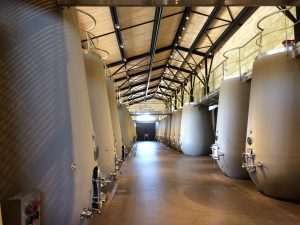
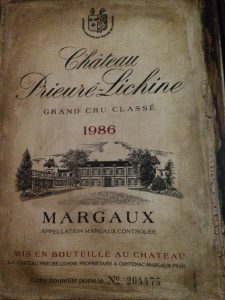
The first stop on our tour took us to Chateau Prieure-Lichine which had Quatrieme Cru classification. This was originally a priory of Benedictine monks who made wine for their own use and eventually for sale under the name Le Prieure de Cantenac. Following its seizure during the French Revolution it changed ownership on several occasions until Alexis Lichine a wine writer bought the estate of eleven neglected hectares of vines in 1951. The current Chateau extends to about 77.5 hectares growing 50% Cabernet Sauvignon, 45% Merlot and 5% Petit Verdot. The wine is fermented in state of the art tulip shaped concrete vats; the old stainless steel vats apparently left an unwanted taste. It is then aged for up to sixteen months in new or once used oak barrels. The oak barrels which are works of art in themselves can cost between €800- €1,000 and are sold off for €45- €60. We tasted samples of red and white wine in the attractive reception area where we were joined by a young Mexican named David who had missed the tour bus. As it turned out he was on the wrong tour having actually booked to go to St.Emilion. I bought a bottle of the 2012 red at €49 the second most expensive bottle of wine I ever bought the first being a delicious red I bought on a very rainy day in Ravello on Italy’s Amalfi Coast which cost me the grand total of €70 and was consumed on the occasion of my 60th Birthday.

Lunch was at Le Savoie restaurant in the village of Margaux where we tasted three red wines from Chateau Rauzan-Gassies one of which a 2004 Appellation Margaux was for me and for David, the highlight of the day. We spent the lunch break chatting about the general lack of appreciation of the average American for good food and fresh produce and reminisced about growing up in our respective countries where fresh produce grown in back gardens was slow cooked by stay at home mothers who had the time and energy to provide their children with good food even if non- essential material goods were lacking. We both bemoaned the election of an ignoramus like Trump to the Whitehouse and I could not help thinking how wrong that fool was about Mexicans as I enjoyed the companionship and conversation of this young man who now working in the USA was a credit to both his own country and to his adoptive home.


At Chateau de la Tour de Bessan, we were given a sample of pure Merlot and pure Cabernet Sauvignon unappealing in themselves and were then asked to guess the percentage of each grape variety in a blend which was more acceptable. Owned by Marie-Laure Lurton and housed in a 1934 former telecommunications building which was renovated by the architect Vincent Defos du Rau the vineyard is certified by Terra Vitis, a certification system that upholds environmentally friendly viticulture practices, since 2003. An art collection added colour and interest to the industrial modern architecture.
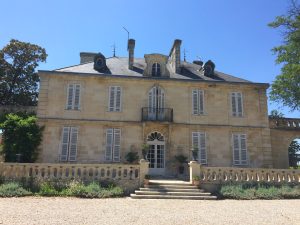
Chateau Kirwan of Troisiemes Crus classification takes its name from an Irishman who married the daughter of Sir John Collingswood a popular wine negociant who bought the Chateau in 1710. Mark Kirwan managed and expanded the vineyards and built the tasteful Chateau which at least to my eyes is more attractive than the overly fussy Chateau Margaux. Thomas Jefferson then Ambassador to France visited Chateau Kirwan in 1780. Owned by Schroder and Schyler a negociant company, Jean Henri Schyler managed the Chateau until his death in 2016 at the age of 85 and his three children are expected to continue the future management. The estate is planted with 45% Cabernet Sauvignon, 30% merlot, 15% Cabernet Franc and 10% Petit Verdot which represents one of the higher mixes of Cabernet Franc and Petit Verdot in the Margaux region. They recently planted a small amount of Carmenere which is used for blending purposes as is petit Verdot . The terroir is gravel, sand and limestone soils, located on one of the highest points in Margaux with its peak elevation in the Cantenac sector reaching 21 meters.
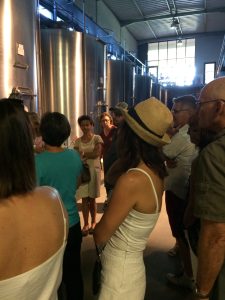

The average age of the vines is 30 years but some of them are close to 60 years old. Here also are tulip shaped cement vats which have been in use at the chateau since 2016. The vats which vary in size allow for parcel by parcel vinification and the wine is aged in about 40% new French Oak barrels for between 18-20 months. As with all the chateaux we visited the cellars and grounds are visually appealing and worth a visit even for the teetotaler. Wine production is the lifeblood of this region and it is impossible to turn a corner without being surrounded by vineyards. There is so much to know about wine, its production and classification that it seems to me that it would take a number of lifetimes to become a true expert on the subject. Thankfully, given the fact that we are not all millionaires, there are enough reasonably priced French wines to be had in each region and when it comes to the crunch the only classification I am really interested in is whether or not it tastes delicious.


