
Leaving the beautiful Majorelle gardens to gathering groups of tourists we headed south west towards the wide streets of the Hivernage, trotting grandly in our horse drawn carriages like ladies of yore. We passed upmarket hotels surrounded by lush greenery and made our way south west to the Menara gardens which were created in the early twelfth century by the Almohad ruler Abd al-Mu’min. The pavilion, or menara from which the name of the gardens derives, was constructed in the 16th century during the time of the Saadian dynasty. An artificial lake irrigated the surrounding gardens using a system of underground channels known as a qanat. The pavilion was renovated in 1869 by the sultan Abderrahman who stayed there in the summertime to escape the oppressive heat and crowds of the city. We left our caleches and walked the long driveway up to the pavilion, running the gauntlet of persistent traders trying to sell us tee-shirts and trinkets we had no desire to own and paid an entrance fee to a rather surly keeper who attempted to give us a tour of the small building much to Judith’s annoyance.

From an upper story balcony we looked east towards the Atlas Mountains through which we would travel next day and whose tips were still covered in snow. From this height we could see the length of the Ave de la Menara as it stretched towards the Koutoubia tower. Below the pavilion is the murky looking pool which was teeming with large carp at the time of our visit which gave the large rectangular shaped artificial pool a sinister air. I wondered just how many bodies had the ancestors of these carp consumed over the centuries. Whatever other delights the gardens may once have contained they were now surrounded by olive trees.
From the Menara gardens we traveled back down the wide avenue and turned south to the Place des Ferblantiers (tinsmiths) in the area around the old Kasbah. It was formerly known as the Place du Mellah when it was part of the now much reduced Jewish quarters which surrounded the Sultans Palace and acted as a buffer between the sultan and his subjects. On one side of the square are the remains of the Badi Palace whose construction began 1578. Moulay Ahmed al Mansur had been nominated as his older brother’s successor after the Moroccan defeat of the Portuguese at the Battle of the Three Kings. He became the most impressive of the Saadians, an Arab dynasty whose rise to power was aided by their religious position as Sharif or descendants of the prophet Mohammad. With the ransom he received for the thousands of Christians captured during the battle, including European nobility, he resolved to build a palace that would impress Europeans visitors to his court. Shiploads of precious material were imported from India and many of the imprisoned Christians who were too poor to be ransomed were put to work on building the palace, which boasted among its decoration which included much gold, marble from Ireland and Italy. There is a long history of white slaves being put to work on such building projects in North Africa. Giles Milton in his book White Gold tells the story of a Cornish cabin boy Thomas Pellows one of a million European slaves many of who died during the construction of palaces and whose bodies were left to rot within their walls when the unfortunate slave died on the job from exhaustion. Moulay Ismael of the succeeding Alawite Dynasty, who rose to power in 1672, and whose reign lasted for fifty-five years, is reputed to have taken ten years to strip the Badi palace of its treasures. He established his capital at Meknes where he built a palace to rival that of Versailles.
We sat and had coffee in the square opposite the red adobe walls of the old Palace on top of which sat one of the ubiquitous storks-nest to be seen on heights throughout the country, and watched the mother stork feeding her two young chicks. Susan and Mary had sampled some good fish tagine at the unremarkable looking café the previous day so we booked a table for seven for later that evening before leaving to explore the surrounding area. As I examined some metal lanterns displayed outside one of the shops I was practically pushed inside the door by a woman who insisted in French that I look inside. Annoyed at her aggressive pushiness I mustered up enough French to respond indignantly, “je sais bien ce que je veux faire” and was duly left alone to browse.


Joining my companions we admired an array of small bowls with metal rims that would make a colorful display for salads and resolved to buy some on our way back through Marrakesh. Judith led us towards what remained of the Mellah whose name derives from the salt used by the Jewish inhabitants in pickling the severed heads of the Sultans enemies prior to their being displayed in the Djemaa el Fna as a deterrent to would be revolutionaries. The area was once home to Jews who had been involved in the Saadian sugar trade, banking, metalwork, jewelry making and tailoring, since 1558. There are few remaining Jews other than those whose bodies lie in the nearby Jewish cemetery most having long departed to Casablanca, France or Israel. Their traditional trades have for the most part been taken over by local Muslims.
On this occasion we had to bypass the nearby Saadian Tombs one of the Kasbah’s important tourist attractions as they were closed to visitors but on previous visit to Marrakesh I had the pleasure of seeing the beautiful stucco and zellij tile work with which the building is decorated; for anyone who would like to know more about the tradition art of Moroccan mosaic decoration known as zellij I would recommend the Caliph’s House a highly enjoyable account of a year the writer Tahir Shah and his wife spent renovating an old palace in Casablanca. The tombs date back to the aforementioned Ahmad al Mansur and contain the remains of about sixty members of the Saadian Dynasty whose origins lie in the Draa River Valley in the south. The building comprises three chambers the best known being that of the twelve pillars whose honeycomb muqarnas stucco-work was once gilded with pure gold. This mausoleum, whose decoration is similar to that of the Alhambra in Granada which was built two hundred years earlier, contains the tomb of Mansur and his two sons which were made from Carrara marble. Outside in the garden are the tombs of over one hundred Saadian Princes and members of their households. The same Moulay Ismael who ransacked the Badi Palace sealed up the entrance to the Saadian Tombs, possibly influenced by the superstition surrounding the destruction of burial grounds. The tombs remained hidden and mostly forgotten apart from the interment of an occasional ruler, including those of the mad Sultan Moulay Yazid who died in 1792, until rediscovered in 1917 by a French aerial survey.
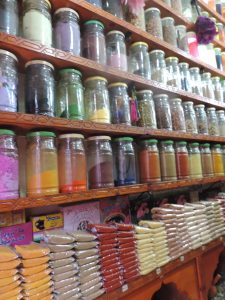
Returning from the mellah we made our way through the narrow passageways of the covered souk where workers were renovating the latticed wooden roofs in traditional style. The latticework provided welcomed shade from the sunshine and light enough to enable us to jump clear of passing scooters and donkeys whose large burdens blocked our passage. The smell of sandalwood and jasmine filled the air and having examined all on show we finally dragged ourselves away from this sensual feast to make our way north- east through more narrow streets to discover that Dar Si Said which houses the Museum of Moroccan Arts was unfortunately closed on Tuesdays. We wandered back to the Djemaa el Fna and had lunch on a rooftop restaurant that overlooked the square.
Recommended Reading.
Giles Milton: White Gold,(2005), Hodder & Stoughton.
Tahir Shah: The Caliph’s House, (2007), Bantham Books.


