
Our next stop would be the beautiful oasis at Tinghir which I had visited on two previous occasions. The first time was on my first visit to Morocco with Judith and Mohammad when we had stayed in a site run by Mohammad’s cousin on the outskirts of town. Known as Camping there was a sign outside that offered Bangalows (sic) for tourists where the accommodation comprised of a cold bare bedroom where I remembering needing a lot of heavy blankets to keep myself warm during an October visit. Thankfully this was made up for by the wonderful meals we ate at Mohammad’s home where his sister Naiema having taken over the running of the kitchen from her mother who felt her cooking days were over after having brought up a family of eight with a husband who was in his ninety fourth year when I first visited and whose youngers son was the delightful fourteen year old Rashid. Friends and family would sit around a small table in the living room where sensible wooden seating with cushions ran along the walls to accommodate social gatherings and those relatives who need to sleep overnight and drink the numerous small cups of sweet mint tea proffered by Mohammad’s mother after she had aerated the liquid by pouring it into a glass and returning the tea to the pot and repeating this procedure a number of times before finally pouring it into glasses for the assembled guests and serving it along with whatever, nuts sweets and biscuits were available. Despite language difficulties much exchanging of news took place, with questions asked about each other’s families and ways of life. Occasionally Judith and I would pop into the kitchen from where delicious aromas wafted their way into the living room and where Naiema cooked a delicious couscous or tajine dish with fresh vegetables picked from the family plot in the oasis. Much time was spent over the mint tea before the main dish was finally served and we gathered around to help ourselves from the large communal dish. All of the meals that Naiema produced were delicious and I particularly remember a lamb tajine with succulent lamb topped with quarters of quince on a bed of buttered couscous the likes of which I never had before or since.


I walked for hours through that peaceful Oasis where I saw my first pomegranate tree in bloom with those delicate magenta blossoms, and saw bunches of ripe grapes being cut from the palm trees. We jumped across the water channels that brought irrigation to the many fruits and vegetables grown in family plots and listened to the birds twitter as my hips began to protest at the distance. We encountered famers with donkeys carrying their load and got a sense of what it must have been like in Biblical times. I can still feel the heat of the sun and the peacefulness of the sound of no traffic and remember the joy of being free to wander through that paradise that was a macrocosm of our childhood garden where my father grew, fruit and vegetables to feed his hungry brood.


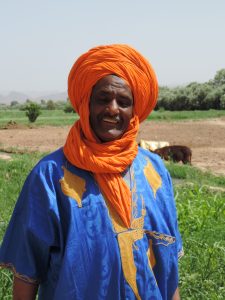
And soon we were led back to the edge of that beautiful oasis when Abdulkhader stopped by the side of a stone wall where a man sat outside dressed in a sky blue didhdasha decorated with a pattern of crescent moons and stars his head crowned with an orange scarf wrapped in that distinctive turban-like Berber way. Our jeeps were parked down a slight slope at the edge of the fields and a man from a nearby house was called on to direct us to the Ikelane mosque through the green foliage of the oasis. We passed beneath date-palms beside plots of land growing abundant vegetables, including potatoes, beetroot, onions, maize, alfalfa, turnips and tomatoes. Trees including pomegranate, mulberry apricot, plumb and almond blossomed all around and even the olive trees were in flower. As always it was such a pleasure to experience that special peace to be found in the natural surroundings of an oasis where the only form of transport to be seen is the donkey and everywhere one is accompanied by bird song. I wracked my brain and managed to remember the name for mulberries (tooth) which impressed Abdulkhader and had been recently learned at the Arabic classes I attended in Dublin. We passed single file through the foliage, jumping over the narrow channels of water that irrigated the fields and finally came to a clearing at the bottom of an abandoned village of Afanour that stretched up a hillside. Making our way a short distance up the hill we came to the 19th century mosque that had once served the village which had been abandoned when housing with electricity was built closer to the town. The mosque was restored in 2007 with the aid of a Spanish architect and the view over the oasis from its roof was spectacular.
Inside the mosque we were joined by the keeper and an aide who showed us around the simple prayer hall which boasted a well from which he drew cups of water which he offered us to drink. We sat in relative silence as Abdulkhader translated the keeper’s words and Rose sitting beside me looked askance at the aide who sat on her other side, a young man who appeared to have some mental condition, as he toyed absentmindedly with a knife. It was somehow made clear through gesture that he was a little simple but harmless and we both breathed a sigh of relief. I would love to have spent time wandering through the abandoned houses whose mudbrick walls were now crumbling back to the ground from which they had arises and to have spent more time walking through the peaceful oasis but Judith wanted us to move on as we would have to negotiate a rope bridge that would bring us across a river to our hotel.

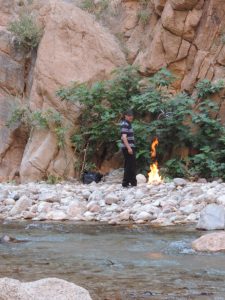

We arrived at a bend in the road and Judith left us to cross the bridge which was only passable on foot to alert the owners of the Hotel that we had arrived. Being used to negotiating the bridge they had promised to help with our luggage and some young men from the hotel soon started to arrive as we unloaded our luggage for an overnight stay. Grapevine grew in abundance and were already lade with bunches of green grapes ready to ripen in the coming months. We said our goodbyes to Abdulkhader who left us for an overnight visit to his family and made our way over the wooden bridge as the water from the snow-capped Atlas Mountains rushed underfoot. Accompanied by the sound of running water and birdsong we made our way up the many steps that led to the Auberge Taborhite which nestled in the shade of orange limestone rock. Passing a small group of visitors who were swimming or sunning themselves by the side of the pool we gathered at reception where we were offered soft drinks as our passports were examined and registration forms filled in. When our rooms were allocated we mounted final flights of stairs, the agile young men helping with our luggage. The remoteness of the location, surrounded by rock on three sides, created the feeling of being in a safe cocoon-like fortress. I lay on a bed in the room I shared with Judith and drifted off for a while before showering and dressing for dinner outside under the marquee.
Outside there was a great bustle as the workers prepared dinner in the hotel kitchen. The group of Australian travelers was already seated to the left side of the marquee and we made ourselves comfortable on the right. They appeared to be in party mood and like us had brought their own wine. Indeed we noticed the familiar sound of champagne bottles being opened and gathered that it was a birthday celebration. When Alice discovered that her camera had run out of power and she had forgotten to bring her recharger one of the young women from the group offered to recharge it for her overnight. The food was good and the young men who served us good humored and efficient and following our meal invited us all into a traditional music session indoors in a large function room. These same young man now doubling as musicians treated us to an evening of Berber music and dancing. Hassan kept the party going with his lively playing and leaving his fellow musicians he danced with any of the women who felt brave enough to give the dance a try. Having some experience of belly dancing I found it easy enough to pick up the steps of his dance as he skillfully led me around the floor and only when encouraged to do so did he feel he had permission to ask Alice and Rose to join him. The evening was an experience and I went off to bed happy with our day’s excursion and with all we had seen and done.
During the night my sleep was interrupted by the sound of Judith’s habitual snoring and I lay semi awake while she went to the loo in total darkness which was a difficult feat given that the sink which was too large for the room made it difficult to negotiate even in daylight. When she returned to bed I thought I might as well use the bathroom too but unlike her turned the light on so as not to injure myself in the pitch blackness only to be chastised as inconsiderate by Judith who seemed to think she had done me a favor in depriving herself of light when I was already awake from her snoring. I retorted in kind and decided in future I would not lie awake suffering the sound of someone else’s snoring.
Next morning I was greeted by Hassan at breakfast and asked if I had slept well. Communicating in French I tried to tell him that I had not as Judith was snoring and as I could not remember the French for snoring I gave him a good impression of what I meant much to his amusement. His good humor was infectious and he told me with pride that he was a Berber from the mountains. We chatted about our journey and where we were heading for next and he said he would have a few days off soon and would visit a friend who worked in Marrakesh. We had enjoyed our stay in the Auberge Taborhite and the same young men who had helped us across the bridge lined up to take our luggage across to our awaiting jeeps. Disconcerted by the fact that we had not met any women working at the Auberge Mary passed some remark to that effect to one of the men who appeared to be in a managerial role. Having lived in the Middle East I have lost any need to tell others how to live. There are so many things I am dissatisfied with regarding the treatment of women in my own culture that I feel we have more in common with women in the Middle East than many imagine. The Egyptian Feminist Nawal Al Sadawwi who was a Psychiatrist and a Minister for Health in Saadat’s Government expresses it well in her book The Hidden Faces of Eve where she compares the more physical restrictions on Muslin women to the Psychological restrictions suffered by women in our own culture all the more insidious because they cannot be seen. Our own culture is still rife with the objectification of women’s bodies and sexual assault on women continues to be widespread as does the physical abuse of women. Western women are expected to be cool with pornography and often collude with this undermining of women. If we thought things had improved for the female of the species all we have to do is look at the election of a serial abuser of women to the American Presidency and the crude misogyny he both appealed to and further activated in all too many American males both those who are supposedly educated and those more deprived. The other monster that women have to grapple with that was brought to the surface during that campaign was that of the women who actively supported the first monster and lend legitimacy to that kind of behavior towards members of their own sex.


